20 Inch Wheels vs 22 Inch Wheels: What Actually Matters
Walk into any wheel shop in Sacramento and you'll hear this debate at least a few times a week. Somebody wants to go from 20s to 22s on their Silverado, or they're buying a used Yukon already on 22s and wondering if they should drop back down. The question of 20 inch wheels vs 22 inch wheels is real, and the answer depends on more than just looks. Ride quality, tire cost, availability, speedometer accuracy, and how your truck handles the railroad crossings on Florin Rd or the expansion joints hammering you on I-5 northbound through downtown - all of it changes when you change wheel size. Here's how we break it down at Tire Geeks, based on the setups we see every week.
Ride Quality: Why the Sidewall Is Everything
The single biggest ride quality difference between 20 inch wheels vs 22 inch wheels is sidewall height. When you go from a 20-inch to a 22-inch wheel while keeping the overall tire diameter the same - which you should, more on that below - the sidewall on the 22-inch tire gets shorter. Less rubber between the road and your rim means less cushion.
On a truck running 275/60R20 tires, you've got about 165mm of sidewall height. Swap to 285/45R22 and you're down to roughly 128mm. That's 37mm less rubber absorbing every pothole, rail crossing, and uneven patch of asphalt. In a perfect world that might not matter much. But Sacramento roads are not a perfect world.
Downtown Sacramento streets near J Street, parts of Meadowview, and the stretch of Stockton Blvd south of Florin Rd are rough. The expansion joints on Highway 99 and I-5 through the Pocket area hit hard. If you're driving a lifted F-150 on 22s with a stiff leveling kit, every one of those joints sends a sharp thud through the cab. The same truck on 20s with a taller sidewall absorbs more of it.
Customers who daily-drive through South Sacramento on beat-up surface streets consistently report that 20-inch setups ride noticeably more comfortably than 22s, all else being equal. On a Tahoe or Yukon running stock suspension, that difference is even more pronounced because those platforms were not designed around 22-inch tire profiles.
That said, the 22-inch ride is not as bad as some people think. Modern tires have improved dramatically. A set of Continental CrossContact LX25 or Michelin Defender LTX M/S in a proper 22-inch fitment rides acceptably well even on rougher Sacramento surface streets. The problem is usually when people push to 24-inch wheels and end up running nearly-zero sidewall rubber - that is where ride quality genuinely suffers. For most people, the jump from 20 to 22 is manageable if the rest of the setup is right.
Tire Availability and Cost Differences
This is where the real-world math starts to sting. 20-inch tires are the sweet spot of the market. Every major brand - Michelin, Goodyear, BFGoodrich, Falken, Nitto, General, Cooper - makes a deep lineup in 20-inch. You can get all-terrain, mud-terrain, highway all-season, performance - whatever you need, and you can find it in stock locally or with a short lead time. Prices in popular 20-inch sizes like 275/60R20 or 285/55R20 typically run $180 to $260 per tire for quality mid-range options, or $280 to $400 for premium names like Michelin LTX or Continental Terrain Contact.
Switch to 22 inches and the selection narrows fast. The most common 22-inch sizes are 265/40R22, 275/45R22, and 285/45R22. In those sizes you will find solid highway touring options from Bridgestone, Pirelli, and Michelin, but the all-terrain and performance selection gets thin. If you run a lifted truck and want a proper off-road-capable tire in a 22-inch size, you are going to be hunting. Most of the aggressive tread patterns simply are not made in 22-inch.
Cost per tire in 22-inch for a quality highway all-season typically runs $220 to $320 for mid-range, and $380 to $520 for Michelin or Continental. A set of four 22-inch tires can easily run $200 to $400 more total than a comparable 20-inch set. Over the life of the vehicle, assuming you replace tires every 50,000 to 60,000 miles, that premium adds up fast.
See our wheel and tire packages Sacramento guide for current package pricing at Tire Geeks, and check the forged vs cast wheels breakdown if you are also deciding on wheel construction along with size.
Keeping Overall Diameter Consistent: The Speedometer Issue
This is the point that trips up more customers than anything else. When people say they want to go from 20-inch wheels to 22-inch wheels, they often assume they can just bolt on any 22-inch tire. That is wrong. What matters is keeping the overall diameter - the total height of the wheel plus tire combined - as close as possible to stock.
A stock Chevy Silverado 1500 might come on 265/65R18 or 275/55R20 depending on trim. If the overall diameter on that tire is roughly 32 inches, you need to find a 22-inch tire that also produces roughly 32 inches overall. If your 22-inch tires are 1.5 inches smaller in diameter than stock, your speedometer will read about 3 mph high at 60 mph. That might sound minor, but it also means your odometer is undercounting miles, which matters for maintenance intervals and can affect warranty claims.
Use the tire size calculator to run your numbers before buying anything. Punch in your stock size, then try different 22-inch options and compare the overall diameter column. Anything within about 1 percent of stock is acceptable. More than 2 percent and you are going to feel it in fuel economy, speedometer accuracy, and potentially in ABS calibration.
Our fitment techs at both locations run these calculations before recommending any wheel and tire package. If you are upsizing to 22s, we make sure the tire size math works before anything goes on the lift.
Clearance: Lifted Trucks vs Stock Rides
Fitment clearance is different for 20s and 22s depending on whether your truck is stock height, leveled, or lifted. Here is how it plays out in practice:
On a stock-height half-ton - Silverado 1500, Ram 1500, F-150 - a 22-inch wheel with a proper +22 to +30 offset typically clears the inner fender, sway bar, and upper control arm without issue. The wheel diameter itself is not the problem; the tire width and offset are. A 285/45R22 on a wheel with aggressive negative offset will poke past the fender flare and rub. A properly-spec'd setup with a hub-centric wheel and correct offset fits fine.
On a leveled truck - say a 2-inch leveling kit on a Ram 1500 or Tundra - you typically gain enough clearance up front to run a 22-inch wheel with a slightly taller or wider tire without contact issues. But you need to verify the backspacing carefully, especially around the inner fender liner on the driver side during full steering lock.
On a lifted truck running 4 to 6 inches of lift, you usually have enough clearance for either 20-inch or 22-inch wheels, but the tire selection matters more than the wheel diameter. A lifted F-250 on 22s running a 285/45R22 highway tire looks awkward under the fenders - the tire looks small against all that lift. Most lifted truck owners stick with 20-inch wheels and run a 35x12.50R20 or 305/55R20 for a more proportional look and better off-road capability.
See the best wheels for trucks Sacramento guide for specifics on offset, backspacing, and fitment clearance by make and model.
Aesthetics: Which Size Looks Better on Which Vehicle
Looks are subjective, but there are patterns we see consistently here in Sacramento.
Full-size trucks (Silverado, Sierra, F-150, Ram 1500): 20-inch wheels look proportional and purposeful on stock-height trucks. 22s look great when the truck is leveled or has a mild 2 to 3 inch lift - they fill the wheel well without the fender gap looking empty. On a heavily lifted truck, 22s often look too small and the setup benefits more from 20-inch wheels with taller tires.
Full-size SUVs (Tahoe, Yukon, Suburban, Expedition): This is the platform where 22-inch wheels shine. The body height and long wheelbase of a Tahoe or Yukon makes 20-inch wheels look almost undersized. 22-inch chrome or machined-face wheels on a blacked-out Yukon Denali are exactly what the platform was styled around. These vehicles on 22s ride acceptably because the suspension geometry is tuned for a heavier load, and the longer wheelbase smooths out minor road imperfections more than a shorter wheelbase truck would.
Cars and crossovers: Most modern cars in the luxury segment now come from the factory on 19s and 20s. Going to 22-inch on a car is a specialty build - lowered luxury sedans, certain Cadillac CT5 builds, big-body sedans like the Chrysler 300. It can look aggressive and dramatic, but the ride quality penalty is significant because the starting suspension travel is already shorter than a truck or SUV. It is a looks-first modification and should be treated that way.
What Sacramento Roads Actually Feel Like on Each Size
We are not a generic tire shop writing for a national audience. Here is what our customers actually tell us about these two sizes on Sacramento roads specifically.
The railroad crossings on Florin Rd between Stockton Blvd and Freeport Blvd are a reliable test. On 20-inch tires with a 60-series sidewall, you feel a firm thump and move on. On 22-inch tires with a 45-series sidewall on a stock-height SUV, that same crossing sends a harder jolt through the steering wheel and seat. Customers with back issues or long commutes notice this immediately.
The I-5 freeway expansion joints through downtown and into Natomas on 22s create a rhythmic pattering sound at highway speed that some owners find annoying. On 20s the same joints are quieter and less intrusive. Highway 99 through the south end, especially from Elk Grove Blvd up through the Valley Hi area, has some wavy sections where 20-inch tires track steadily and 22-inch tires with less sidewall feel more nervous over undulations.
On the other hand, if your Tahoe is doing Arden Way and Fair Oaks Blvd every day - smooth suburban arterials with good pavement - or you are on I-80 to and from Roseville or Citrus Heights, you will barely notice the difference. The roads that expose the ride difference are the rough inner-city streets and the older freeway sections, not the newer highway corridors.
For customers who take their trucks up to Tahoe on weekends, 20-inch wheels with an all-terrain or winter tire option give you more flexibility than 22-inch wheels, where quality winter-capable options are limited.
Quick Comparison: 20-Inch vs 22-Inch Wheels
| Factor | 20-Inch Wheels | 22-Inch Wheels |
|---|---|---|
| Ride quality | Softer, more forgiving on rough roads | Firmer, harsher over potholes and joints |
| Tire selection | Excellent - every brand and category | Moderate - strong highway, limited off-road |
| Tire cost (set of 4) | $700 to $1,400 for quality options | $900 to $1,800 for comparable quality |
| Best for lifted trucks | Yes - pairs well with taller, wider tires | Less ideal - limited aggressive tire options |
| Best for full-size SUVs | Works fine, can look slightly small | Excellent - proportional and sharp-looking |
| Winter/Tahoe tire options | Wide selection of snow-capable tires | Limited options, mostly all-season only |
| Speedometer sensitivity | Easier to match stock diameter | Requires careful size selection to stay accurate |
Our Recommendation by Use Case
Daily driver truck on Sacramento roads, stock or leveled: 20-inch wheels. Better ride quality, cheaper tires, more selection. You will not regret it when you hit the Florin Rd crossing at 35 mph.
Lifted truck 4 inches or more: 20-inch wheels with a quality 35-inch or 305-series tire. The setup looks right, rides better, and you have actual off-road tire options if you want them.
Full-size SUV (Tahoe, Yukon, Suburban, Expedition) used primarily on highways and city streets: 22-inch wheels. This is the sweet spot for that vehicle type. The look is proportional and the ride penalty is manageable.
Luxury car or performance build: Depends on the platform. We assess this case by case. Come in and we'll look at your specific vehicle, suspension setup, and goals before recommending anything.
Budget-conscious upgrade: 20-inch every time. You will spend less on wheels, less on tires every replacement cycle, and have more flexibility.
Explore our full wheel and tire services to see what we install and carry, and visit our Sacramento locations page for directions, hours, and photos of both shops.
Frequently Asked Questions
Do 22-inch wheels ride rougher than 20-inch wheels on Sacramento streets?
Yes, in most cases. The shorter sidewall on 22-inch tires means less rubber cushion between the rim and the road. On rough Sacramento streets - particularly downtown, Florin Rd, and older sections of Highway 99 - the difference in harshness is noticeable. Full-size SUVs with longer wheelbases feel the difference less than shorter-wheelbase trucks.
Are 22-inch tires more expensive than 20-inch tires?
Generally yes, by $50 to $100 per tire for comparable quality levels, and sometimes more. A quality 20-inch all-season truck tire might run $200 to $260 per corner, while the same-brand 22-inch equivalent often lands at $260 to $350. Over a full set of four, that's $200 to $400 more per tire replacement cycle.
Can I put 22-inch wheels on my stock-height truck without rubbing?
Often yes, but offset and tire width are critical. A 22-inch wheel with the correct positive offset and a tire width matching your fender clearance will fit without rubbing. The wrong offset - especially too much negative - will push the tire past the fender flare during turning. Have a fitment tech verify your specific truck's clearances before buying. We do this at both Tire Geeks locations at no charge when you are buying a package from us.
Will 22-inch wheels mess up my speedometer?
Only if you pick the wrong tire size. As long as the 22-inch tire produces the same overall diameter as your stock setup, the speedometer stays accurate. If the overall diameter is off by more than about 1 to 2 percent, the speedometer will read incorrectly. Use a tire size calculator to compare overall diameters before finalizing your purchase - we always do this calculation for customers choosing an upsized wheel.
Which size looks better on a Chevy Tahoe or GMC Yukon?
22-inch wheels are almost universally considered the better-looking option on full-size SUVs like the Tahoe, Yukon, and Suburban. The larger wheel fills the wheel well more proportionally given the vehicle's height and body length. Chrome, machined, or gloss-black 22-inch wheels on a Denali or Premier trim level are a sharp look and what most of our full-size SUV customers choose.
What size should I run if I want to take my truck to Tahoe for skiing or off-roading?
Stay with 20-inch wheels. Winter tire and snow-capable all-terrain options are dramatically wider in 20-inch than 22-inch. You can get aggressive all-terrain tires like the BFGoodrich KO2 or Falken Wildpeak AT3W in excellent 20-inch fitments for Tahoe driving. In 22-inch, your options shrink to mostly highway all-season tires that are not ideal in snow or on gravel forest roads. If you need one set of wheels and tires to handle both Sacramento daily driving and Sierra trips, 20-inch is the practical choice.
Come See Us at Either Tire Geeks Location
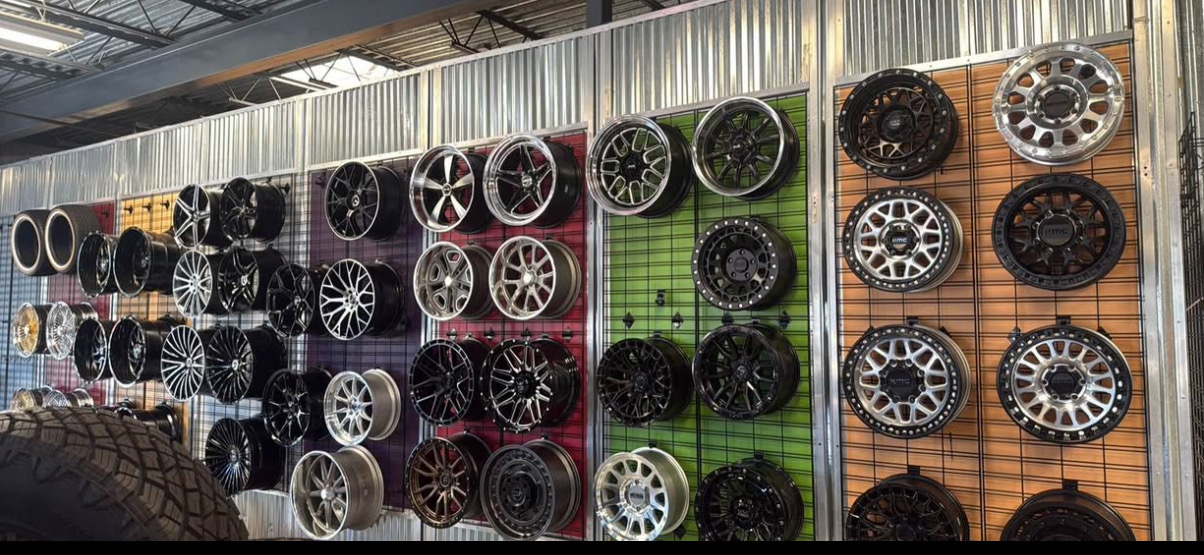
If you are still deciding between 20-inch and 22-inch wheels for your truck or SUV, the best move is to come in and look at actual mounted examples on vehicles similar to yours. We have both sizes on display and our fitment techs can pull up your vehicle's exact clearances and recommend the right offset and tire size before you spend a dollar.
We also offer flexible financing through Acima - no traditional credit check, roughly 60-second application, 90-day same-as-cash option. Whether you are buying a wheel and tire package, a lift kit, or just tires, financing is available on the full setup.
Visit us at 3020 Florin Rd, (916) 800-8786 in South Sacramento, or at 2245 Arden Way, (916) 913-8786 near Arden-Arcade. Both locations are open Monday through Saturday, 9 AM to 6 PM. Walk in today - no appointment needed. Have questions first? Reach us through our contact page and we'll get back to you fast.