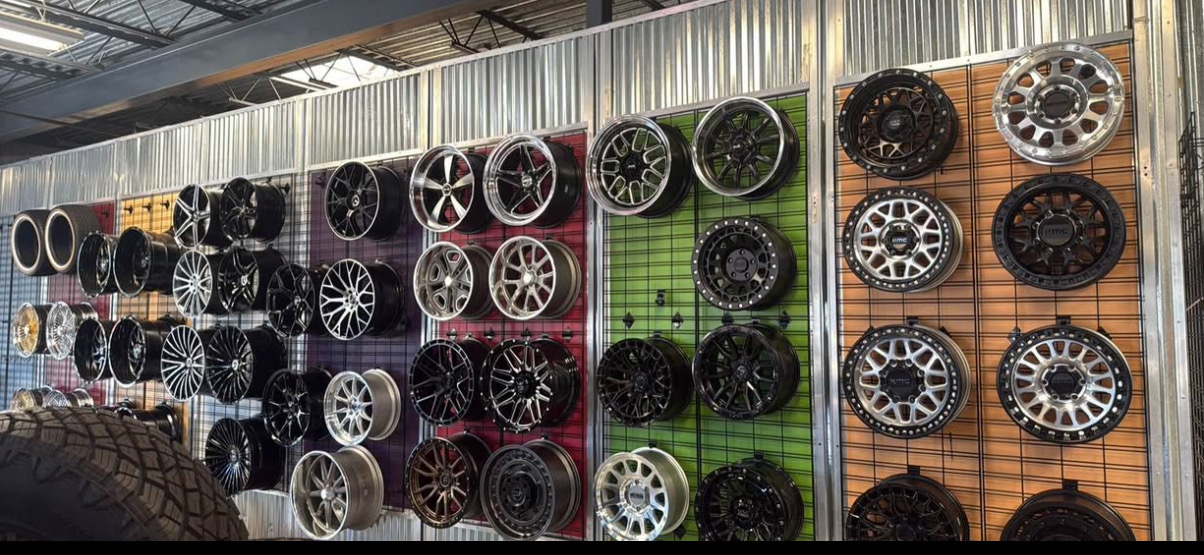
Knowing how to choose aftermarket wheels correctly is the difference between a setup that looks sharp and drives perfectly and one that rubs your fenders at every speed bump on Florin Rd or wears your wheel bearings into the ground by 50,000 miles. We see both outcomes at Tire Geeks every week. The good news is that fitment is not complicated once you understand the five numbers that actually matter. This guide walks you through every one of them so you can shop confidently - or at least walk in and have an informed conversation with us before we do the measuring ourselves.
How to Choose Aftermarket Wheels: The Five Fitment Numbers
Every wheel has five core specs. Get all five right and the wheel fits. Miss any one of them and you are looking at rubbing, vibration, bearing damage, or a TPMS light that never goes away. Here they are:
- Bolt pattern (also called PCD - pitch circle diameter)
- Offset (how far in or out the mounting face sits)
- Backspacing (related to offset, measured differently)
- Hub bore (center hole diameter)
- Load rating (especially critical on trucks and SUVs)
After those five, you layer in diameter and width choices - which directly affect what tire sizes you can run. Let's go through each one.
Bolt Pattern: Measuring 5x114.3 and Every Other Common Size
The bolt pattern tells you how many lug holes the wheel has and the diameter of the imaginary circle they sit on. A 5x114.3 wheel has 5 lugs arranged on a 114.3mm circle. A 6x139.7 wheel - extremely common on full-size trucks like F-150s, Silverados, and Tundras - has 6 lugs on a 139.7mm circle. These numbers are not interchangeable. A Tacoma runs 6x139.7. A Honda Civic runs 5x114.3. Same lug count, totally different circle, will not mount.
For our full deep-dive on measuring bolt patterns yourself - including the easy diagonal method for 5-lug wheels and how to confirm odd patterns like 5x100 vs 5x114.3 when you are not sure - read our complete wheel bolt pattern guide. That post covers every common Sacramento-area vehicle pattern and the few cases where adapters make sense (and when they do not).
Common bolt patterns we see every day at the shop:
- 5x114.3 - Camry, Accord, Mustang, many Nissans, older Jeeps
- 5x120 - BMW, newer GM trucks and SUVs (Colorado, Traverse)
- 5x127 - Jeep Wrangler JK/JL, Ram 1500 (older gen)
- 6x135 - Ford F-150 (2004-present)
- 6x139.7 - Toyota Tundra, Tacoma, Chevy Silverado 1500, GMC Sierra
- 8x165.1 / 8x170 - Heavy duty trucks: Ram HD, Silverado 2500/3500, Super Duty
If you are measuring at home on a 5-lug wheel, measure from the center of one lug hole to the outer edge of the hole directly across from it - that distance in millimeters is your PCD. On 4-lug and 6-lug wheels you can measure directly across between opposite holes center-to-center.
Offset: The Number That Controls How Your Wheels Sit
Offset is the distance in millimeters between the wheel's mounting face and its true centerline. Positive offset means the mounting face is pushed toward the street side of the wheel - the wheel sits tucked inward, under the fender. Negative offset means the mounting face is toward the brake side - the wheel sits pushed out, more flush with or outside the fender lip. Zero offset means the mounting face is exactly at the centerline.
A stock 2023 Toyota Camry might run ET45 (positive 45mm). A truck owner adding a 2-inch leveling kit and going to an aggressive wheel stance might want ET+10 or even ET-12, which pulls the wheel face outward and fills the fender well. The math is precise: moving from ET45 to ET25 on the same width wheel pushes the face outward 20mm - about 3/4 of an inch.
For a thorough explanation with diagrams and real-world examples, see our post on wheel offset explained in detail. That guide covers how offset interacts with suspension geometry, steering feel, and bearing loads - all the things that matter beyond just looks.
What goes wrong with bad offset:
- Too much positive offset - wheel sits deep in the well, tire rubs inner fender liner or suspension components, especially when turning
- Too much negative offset - wheel sticks out past the fender, illegal in California if it protrudes beyond the fender line, and puts severe lateral load on the outer wheel bearing
- Mismatched front-to-rear offset - handling imbalance, uneven wear
Backspacing: The Other Way to Measure the Same Thing
Backspacing is the distance from the back lip of the wheel barrel to the mounting face, measured in inches. It is related to offset but calculated differently, and wheel manufacturers use both systems. If you are shopping truck wheels - especially in the lifted-truck market - you will see backspacing quoted constantly. A 6-inch backspace on a 9-inch-wide wheel works out to roughly ET0. A 4.75-inch backspace on the same wheel is about ET-18.
To convert: Backspace = (wheel width in inches / 2 + 0.5 inches for bead seat lip) + (offset in mm / 25.4). You do not need to memorize the formula - tell us the wheel you are considering and we will confirm whether it works on your vehicle before you commit.
Hub Bore: Hub-Centric vs Lug-Centric and Why Hub Rings Matter
The center bore is the hole in the middle of the wheel that slides over the hub. On a hub-centric wheel, this hole matches the hub diameter exactly - the hub carries the wheel's weight and keeps it perfectly centered. On a lug-centric wheel, the center hole is larger than the hub (to fit multiple vehicle applications) and the lug nuts alone center and support the wheel.
Common hub bore sizes in Sacramento traffic:
- 54.1mm - many Hondas
- 56.1mm - many Toyotas
- 60.1mm - many Nissans, some Mazdas
- 67.1mm - most GM cars and trucks
- 71.5mm - Ford F-150
- 87.1mm - Ram 1500 (older)
If your aftermarket wheel's center bore is larger than your hub, you need hub-centric rings - plastic or aluminum rings that fill the gap and make the fitment hub-centric. Without them on a lug-centric setup, the lug nuts will hold the wheel on, but at highway speed you may feel a vibration that no amount of rebalancing will fix. The wheel is wobbling microscopically around the larger center hole. We stock hub rings in every common size and they typically cost $10-$30 for a set of four. On a $1,500 wheel set, skip this step and you will be frustrated.
Load Rating: Non-Negotiable on Trucks and SUVs
Every wheel has a maximum load rating stamped or cast into the back of the barrel. This number tells you the maximum weight that wheel is tested and rated to carry. For a passenger car, most aftermarket wheels rated at 1,500-1,800 lbs per wheel are more than adequate. For a truck or SUV - especially one that tows, carries payload, or goes off-road on the Rubicon Trail - you need to match or exceed the OEM load rating.
A 2023 Ram 1500 with a 2,320-lb-per-corner GVWR rating is not compatible with cheap cast wheels rated at 1,800 lbs. That is not a worst-case scenario - it is a math problem. Full-size truck owners moving to 20-inch or 22-inch wheels should be looking at forged aluminum or high-quality flow-formed wheels rated at 2,200+ lbs per wheel. For truck-specific wheel recommendations, take a look at our post on best wheels for trucks in Sacramento which covers material, construction, and load rating by application.
Signs a wheel is underrated for the application:
- Cracks starting from lug holes outward (fatigue failure)
- Barrel distortion after moderate off-road use
- Wheel wobble that appears under loaded conditions only
Diameter and Width: Matching the Wheel to the Tire
Wheel diameter is measured from bead seat to bead seat across the wheel, not outer lip to outer lip. A 20x9 wheel is 20 inches in diameter and 9 inches wide at the bead seats. The common upgrade from stock 17s or 18s to 20s is mostly aesthetic - you gain nothing in performance on street vehicles, and you typically trade some ride comfort because you are running lower-profile tires to maintain the same overall diameter.
Width matters because it determines what tire widths mount correctly. General guidelines:
| Wheel Width | Ideal Tire Width Range | Acceptable Range |
|---|---|---|
| 7 inches | 195-215mm | 185-225mm |
| 8 inches | 215-235mm | 205-245mm |
| 8.5 inches | 225-245mm | 215-255mm |
| 9 inches | 235-265mm | 225-275mm |
| 10 inches | 265-295mm | 255-305mm |
| 12 inches | 305-345mm | 295-355mm |
Mounting a 235mm tire on a 9-inch wheel is fine. Mounting a 235mm tire on a 10.5-inch wheel stretches the sidewall dangerously thin - a style called tire stretching that looks aggressive but structurally compromises the tire's sidewall integrity. We will not mount stretched tire setups at Tire Geeks for safety reasons. Going the other direction - a very narrow tire on a very wide wheel - causes the tire to balloon outward unnaturally, affecting handling and increasing the risk of sidewall failure on sharp impacts.
The Test Fit: Do Not Skip This Step
Even when all five numbers look correct on paper, always do a dry test fit before mounting tires. Mount the bare wheel on the hub, hand-tighten the lug nuts, and then:
- Turn the wheel full lock in both directions - check for any contact with the inner fender, strut, or brake caliper
- Compress the suspension by hand or with a pry bar to simulate bump travel - check for contact at the top of the wheel well
- Check the outer edge of the tire (if you can simulate tire width with a tape measure) against the fender lip
- Confirm the lug nuts seat fully and that there is no gap indicating the lug nut taper does not match the wheel's seat type
Lug nut seat type is a detail many people miss. Most factory wheels use a conical (tapered) seat at 60 degrees. Some aftermarket wheels use a ball (radius) seat or a flat washer seat. Use the wrong lug nut and it will not seat properly - the wheel will vibrate and the lug can back off over time. Every set of aftermarket wheels we sell at Tire Geeks includes the correct lug nuts for that wheel.
Why Professional Fitment Saves Money Long-Term
Rubbing is the obvious problem everyone worries about. But the more expensive long-term issues are subtler. Running wheels with excessive negative offset puts constant lateral stress on the outer wheel bearing - a part that was designed for vertical load. We see premature wheel bearing failures on Sacramento-area trucks that had wheels installed with too much poke and no one told the owner. At $300-$600 per bearing plus labor, that adds up fast.
TPMS sensors are another source of frustration. California requires functioning TPMS, and aftermarket wheels often require new sensors or reprogramming of the existing sensors. If we mount wheels and do not address the sensors, your TPMS light stays on permanently. We handle sensor transfer, new sensor installation, and programming in-house at both locations so you leave with everything working.
Torque specs matter too. Lug nuts on aluminum wheels need to be torqued to spec with a calibrated torque wrench - not an impact gun set to max. Over-torquing warps rotors and stretches lug studs. Under-torquing leads to loose wheels. We torque every wheel set with a calibrated torque wrench at installation and recommend a re-torque check after the first 25-50 miles.
Our full wheel and tire services include everything from a basic fitment consultation to a complete mounted, balanced, TPMS-programmed, torqued installation. Check out our financing options through Acima if you are looking at a full wheel and tire package - the application takes about 60 seconds, there is no traditional credit check, and there is a 90-day same-as-cash option.
Frequently Asked Questions
How do I know what bolt pattern my car has?
The easiest way is to look up your year, make, and model on a fitment database - most tire and wheel retailer websites have these. You can also measure it yourself: for a 5-lug wheel, measure from the center of one hole to the outer edge of the hole directly across it in millimeters. That number is your PCD. Our wheel bolt pattern guide has step-by-step instructions for every lug count including 4, 5, 6, and 8-lug patterns.
Can I put wheels with a different offset than stock on my car?
Yes, within limits. Most vehicles tolerate a range of roughly 10-15mm from stock offset without issues. Going further requires checking for clearance at every suspension position, and may require a spacer or adapter, or trigger a need for fender rolling. The wheel offset guide explains how to calculate whether a new offset will fit and what the consequences are of going too far in either direction.
Do I need hub rings when I buy aftermarket wheels?
If the aftermarket wheel's center bore is larger than your hub, yes. Almost all quality aftermarket brands machine their wheels to a universal bore (like 73.1mm or 74.1mm) to fit multiple vehicles. If your hub is 54.1mm (Honda) or 60.1mm (Nissan), you have a significant gap that needs to be filled. Without hub rings, you may experience a vibration at highway speed that cannot be balanced out. We include hub rings where needed on every wheel sale.
What load rating do I need for my truck?
Check your door jamb sticker for GVWR, then divide by 4 to get the per-corner load. Your wheels should be rated at or above that number. For a half-ton truck like a Silverado 1500 or F-150, look for wheels rated at 2,000 lbs per wheel minimum. For HD trucks towing anything serious, 2,500+ lbs per wheel and forged construction is what we recommend. Never sacrifice load rating to hit a price point on trucks.
Will bigger wheels hurt my ride quality?
Going from 17-inch to 20-inch wheels usually means dropping from a 60-series tire to a 45-series tire to maintain the same overall diameter. Lower profile means less sidewall to absorb impacts. On smooth Sacramento freeways like Highway 50 or Business 80 you will barely notice. On rough patches like the railroad crossings on Florin Rd, or after a pothole on Watt Ave, the difference is real. 22-inch and larger wheels amplify this further. It is a trade-off you should go in knowing about.
How long does a wheel fitment check take at Tire Geeks?
A fitment consultation where we look up your vehicle specs, confirm bolt pattern and hub bore, and help you select a wheel from our inventory takes 15-20 minutes. Full mount, balance, TPMS programming, and installation of a set of four wheels and tires typically runs 60-90 minutes. Walk-ins are welcome at both locations - no appointment needed - and we do our best to get you out in one stop. Visit our locations page for hours and directions, or contact us if you have fitment questions before you come in.
Come In and Let Us Measure Your Vehicle
Reading about fitment is useful. Pulling your exact hub bore with a vernier caliper and test-fitting the wheel you want to buy before you commit is better. At Tire Geeks we do this every day for customers from Elk Grove, Arden-Arcade, Carmichael, Natomas, Rancho Cordova, and every other corner of Sacramento. Bring your vehicle to us and we will confirm every fitment number, show you options in person, and get you rolling on wheels that actually fit.
South Sacramento: 3020 Florin Rd, (916) 800-8786
Arden area: 2245 Arden Way, (916) 913-8786
Open Monday through Saturday, 9 AM to 6 PM. Walk in today - no appointment needed.